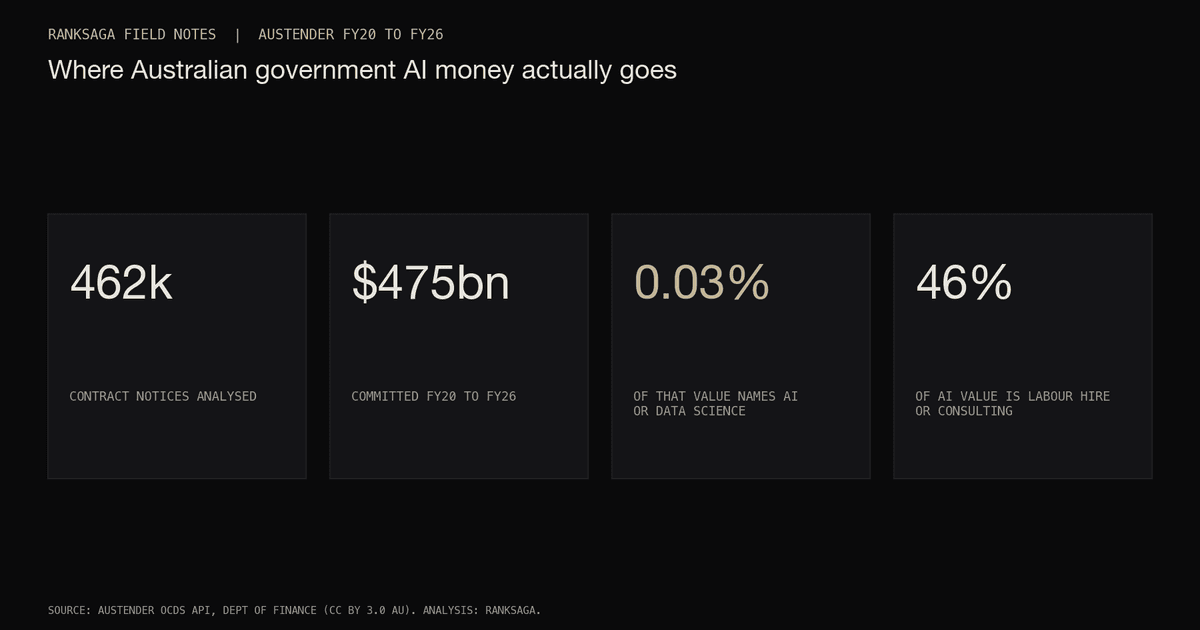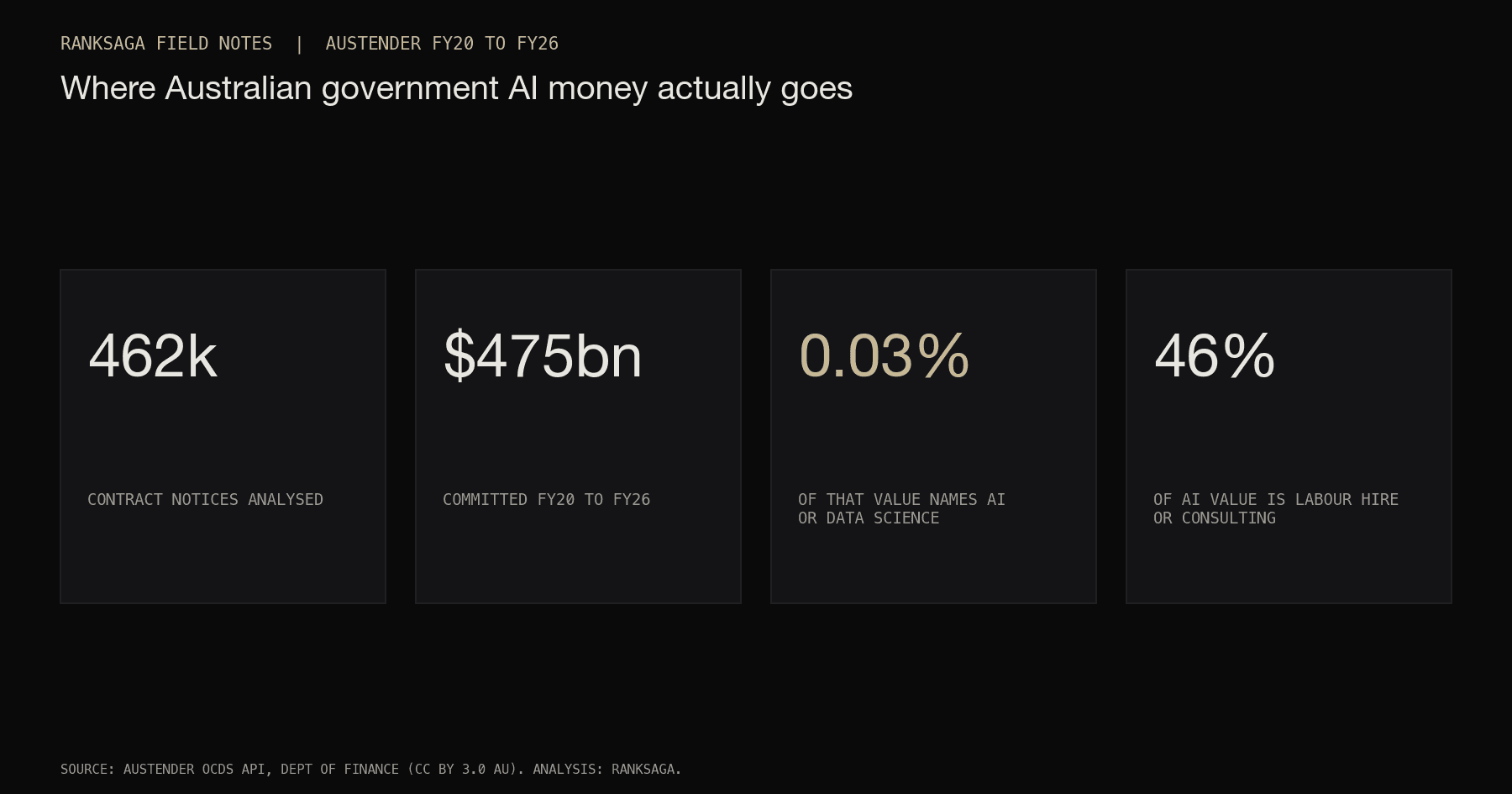
Every minister has an AI story. Every agency has an AI strategy. So we went to the one record that cannot be spun: the contract notices that Commonwealth agencies are required to publish on AusTender. We pulled all of them, 461,982 contract notices worth $499bn signed between 1 July 2019 and 23 November 2026, and asked a simple question. Where is the AI money going?
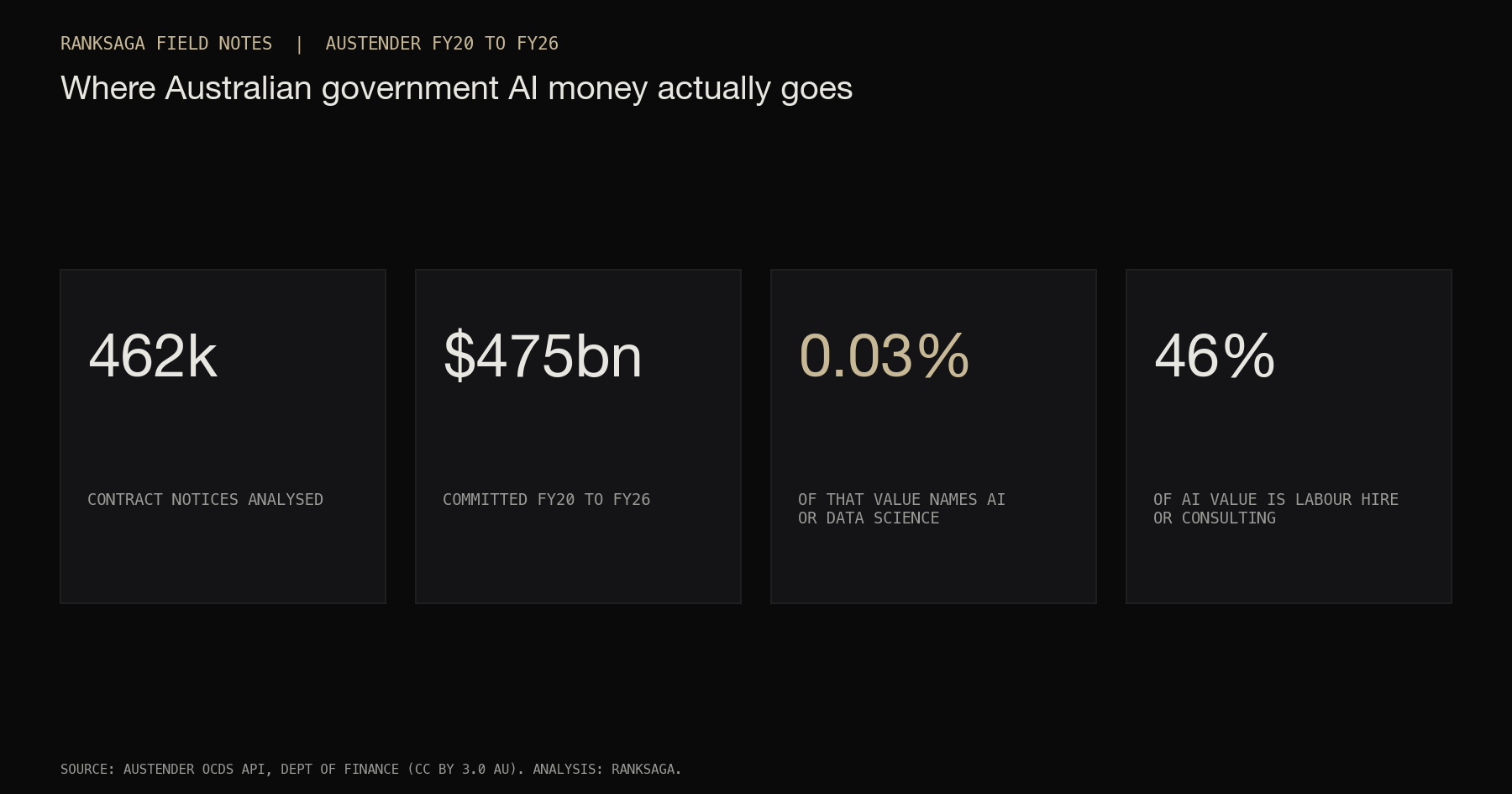
The answer is uncomfortable. Contracts that name AI, machine learning or data science add up to $132m across seven and a half years. Over the six full financial years from FY20 to FY26 that is 0.03% of all contract value. About half of it buys people by the hour, not systems. And the largest AI-adjacent spend in the country, Defence's investment in autonomous and uncrewed systems, does not use the word AI at all.
Five findings
- AI is a rounding error in the contract record. $124m of the $475bn committed from FY20 to FY26 names AI or data science. Strip out data science job titles and it falls to $82m.
- Momentum is real, from a tiny base. Notices naming AI rose from 32 in FY20 to 93 in FY26. Notices naming AI explicitly (excluding data science roles) went from 22 to 85.
- Government is buying AI by the hour. 46% of AI contract value is labour hire or consulting, rising to 56% if you remove a single $24m software renewal. The median AI contract is $158k and runs for under a year. 94% are below $1m.
- Defence's AI does not say "AI". Defence holds 55% of all contract value but only 15% of the value of contracts that name AI. Meanwhile it holds 99% of the $3.2bn committed to autonomous and uncrewed systems, 24 times the value of every contract that names AI.
- The platform layer is concentrated. 7,152 suppliers won ICT work from FY20 to FY26. The top 1% of them hold 66% of the value. AI is starting to arrive inside those platform renewals, where it is even harder to see.
The dataset
AusTender is the Australian Government's procurement system, run by the Department of Finance. Under the Commonwealth Procurement Rules, agencies must publish a contract notice for every contract worth $10,000 or more within 42 days. Finance exposes those notices through a public Open Contracting Data Standard API, licensed CC BY 3.0 AU.
We pulled every notice published from July 2019 onward (6,484 API pages, about 635,000 releases including amendments) and kept the latest version of each contract, so amended contracts carry their current total value. Each row has the agency, the supplier and ABN, the UNSPSC category code, a free-text description, the value, the contract period and the procurement method.
We then tagged each contract:
- ICT: UNSPSC segment 43 (IT and telecommunications), plus computer services (8111) and IT service delivery (8116).
- Names AI: the description mentions artificial intelligence, machine learning, deep learning, LLMs, generative AI, Copilot, ChatGPT, computer vision, NLP, data science and related terms. We read all 354 matches by hand and removed 9 false positives, including "AI" meaning avian influenza and a farming research project called AI-Com.
- Autonomous and uncrewed systems: autonomous vehicles and systems, uncrewed or unmanned aerial, surface and undersea systems, drones and counter-drone systems.
- Labour hire and consulting: UNSPSC temporary personnel and management advisory codes, plus descriptions such as "ICT Contractor", "Labour Hire" and "LH-" requisition numbers.
- Defence portfolio: the Department of Defence, the Australian Signals Directorate and the Australian Submarine Agency.
Australian financial years run July to June, so FY26 is July 2025 to June 2026. FY27 is partial (July to November 2026) and is excluded from year-on-year comparisons.
1. AI is a rounding error in the contract record
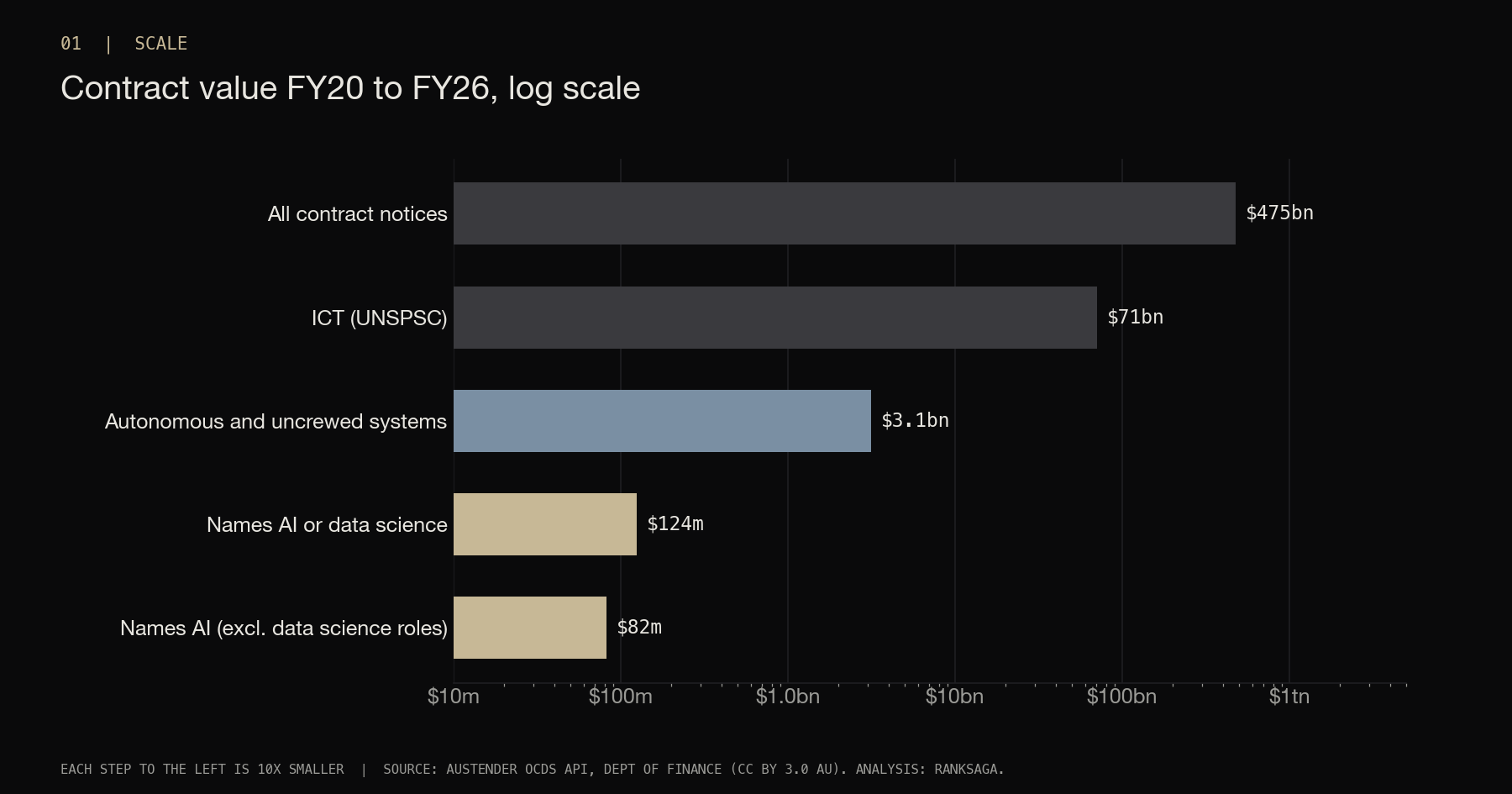
Each step down that chart is roughly an order of magnitude. ICT is about 15% of everything the Commonwealth signs. Autonomous systems are a few percent of ICT. Contracts that name AI are a few percent of autonomy.
In FY26, the strongest year on record, contracts naming AI were worth $48m against $6.3bn of ICT contracts. That is 0.77% of ICT value, and half of the $48m is one contract: the Australian Taxation Office's $24m renewal of Teradata software subscriptions, support "and AI services". Take that out and the FY26 figure is closer to 0.4%.
This does not mean government is not using AI. It means the procurement record cannot see it. AI is being bought as a feature of platforms already under contract, as a skill inside a contractor's job title, and as a capability inside a weapons system. None of those show up as an AI line item.
2. Momentum is real, from a tiny base
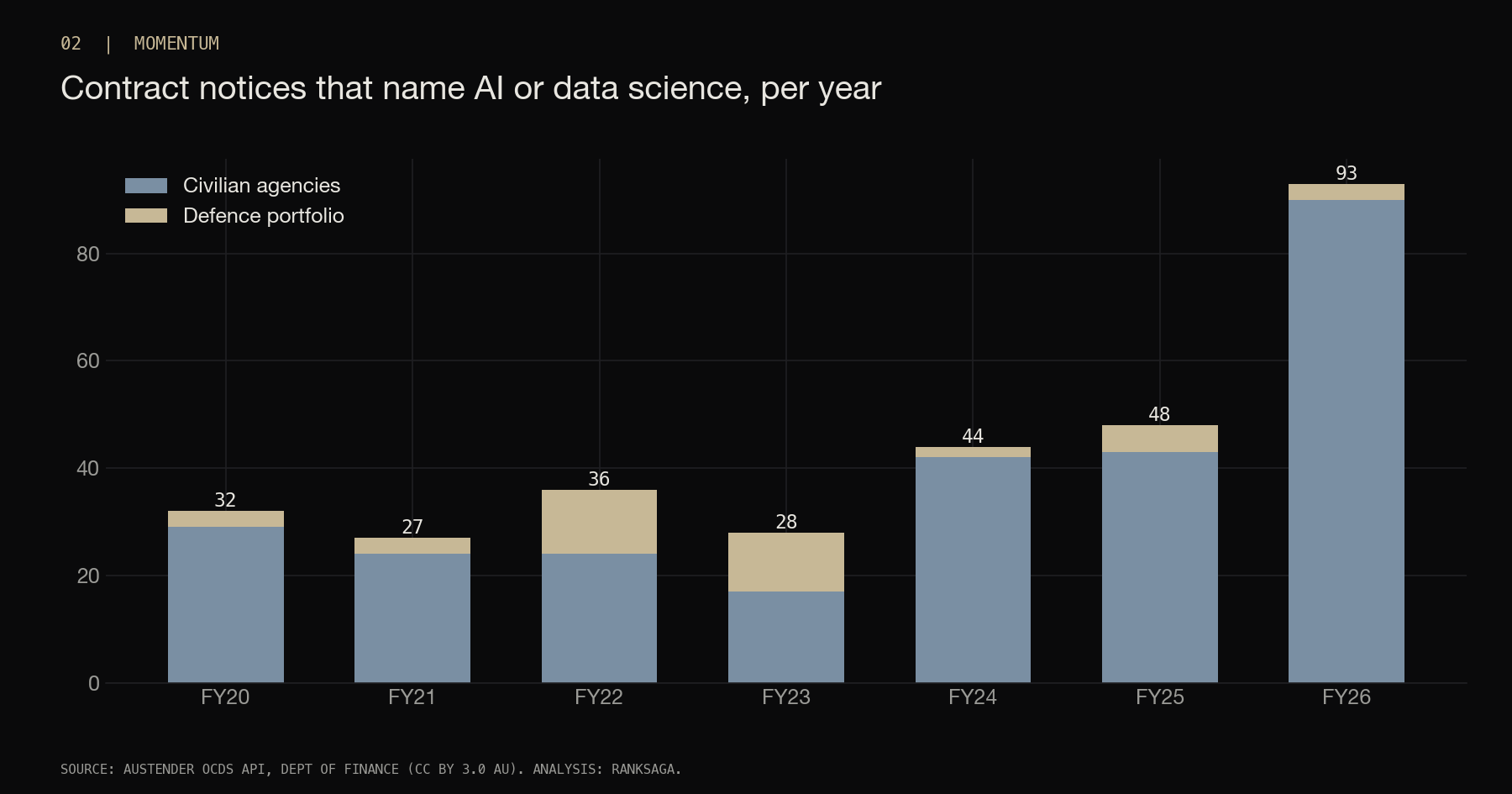
For four years the count was flat at roughly 30 notices a year. It began to move in FY24 and almost doubled in FY26 to 93. The mix changed too. Early notices were mostly data scientist roles and university research. FY26 notices read like an adoption wave: Copilot implementation services, AI training for executives, AI governance reviews, ChatGPT Enterprise subscriptions, generative AI proofs of concept and an APS-wide AI pilot program.
Civilian agencies drive almost all of it. Defence portfolio agencies account for a handful of notices each year, and in FY26 just 3 of the 93.
3. Government is buying AI by the hour
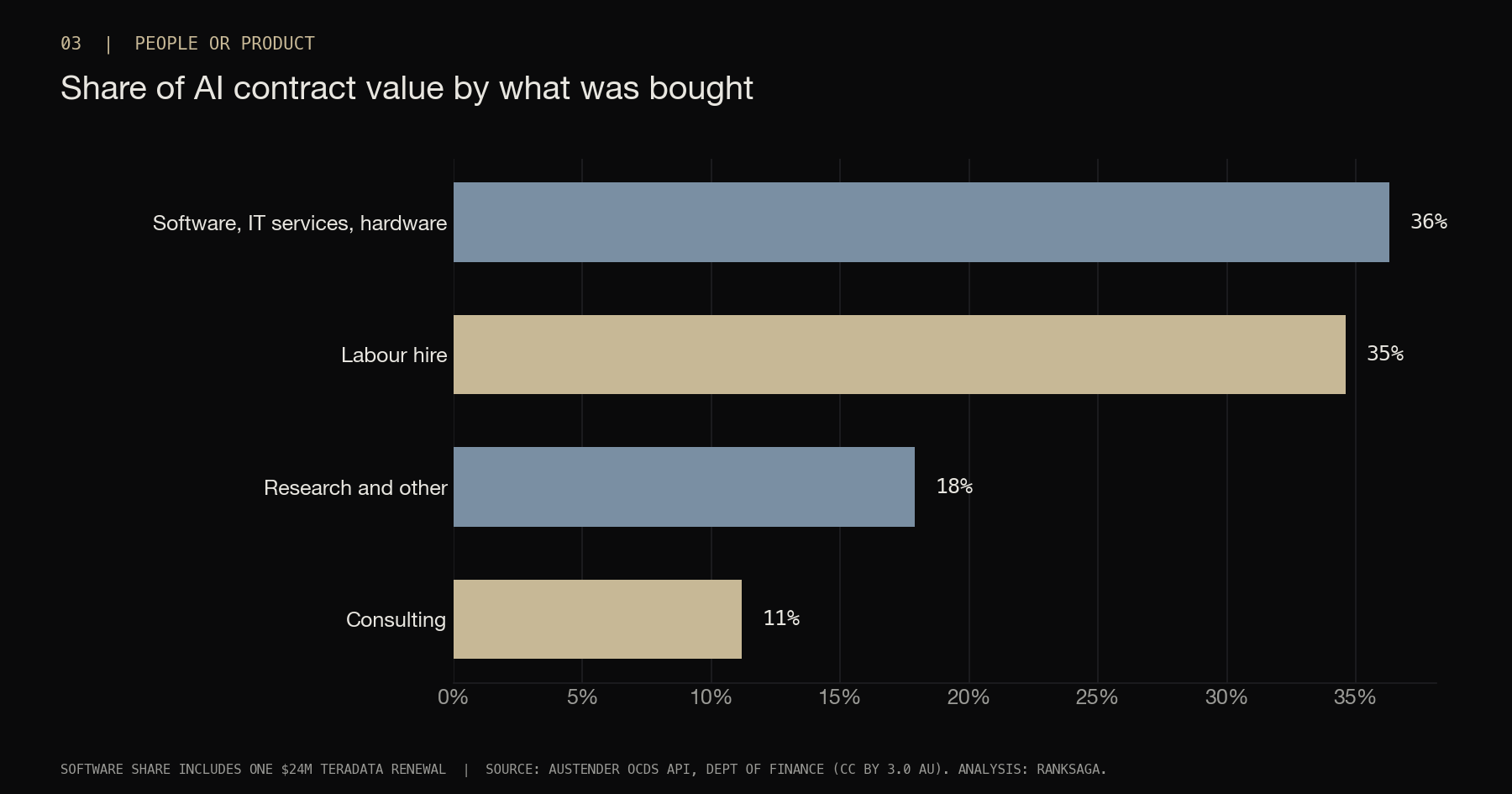
When an agency does write "AI" on a contract, it is usually buying a person. Labour hire and consulting account for 46% of AI contract value and 52% of AI contracts. If you remove the single Teradata renewal, people account for 56% of the value. Software, IT services and hardware together make up a little over a third. The remainder is mostly research grants, largely agricultural machine learning funded by the Grains Research and Development Corporation.
The supplier list tells the same story. After Teradata, the second largest supplier of "AI" to the Commonwealth by contract value is a recruitment firm, Hays, with $6.6m. Of the 345 contracts that name AI, 110 qualify only because they mention data science, and 74 of those are simply a data scientist role.
| Rank | Agency | Supplier | Description | Value |
|---|---|---|---|---|
| 1 | Australian Taxation Office | Teradata | Software subscriptions, support and AI services | $24m |
| 2 | Department of Defence | SQC | Developing quantum machine learning capability | $3.2m |
| 3 | Australian Taxation Office | NTT Australia | Cloudera Data Hub and Data Science Workbench licences | $2.9m |
| 4 | Grains R&D Corporation | CSIRO | AI tools for plant breeders | $2.7m |
| 5 | Grains R&D Corporation | University of Sydney | Machine learning models for 3D soil mapping | $2.2m |
| 6 | Services Australia | McKinsey | Artificial intelligence design services | $1.7m |
| 7 | Reserve Bank of Australia | Data#3 | Microsoft 365 commitment including Copilot | $1.4m |
| 8 | Grains R&D Corporation | University of Adelaide | Machine learning for soil and crop variability | $1.4m |
The eight largest contracts naming AI, July 2019 to November 2026.
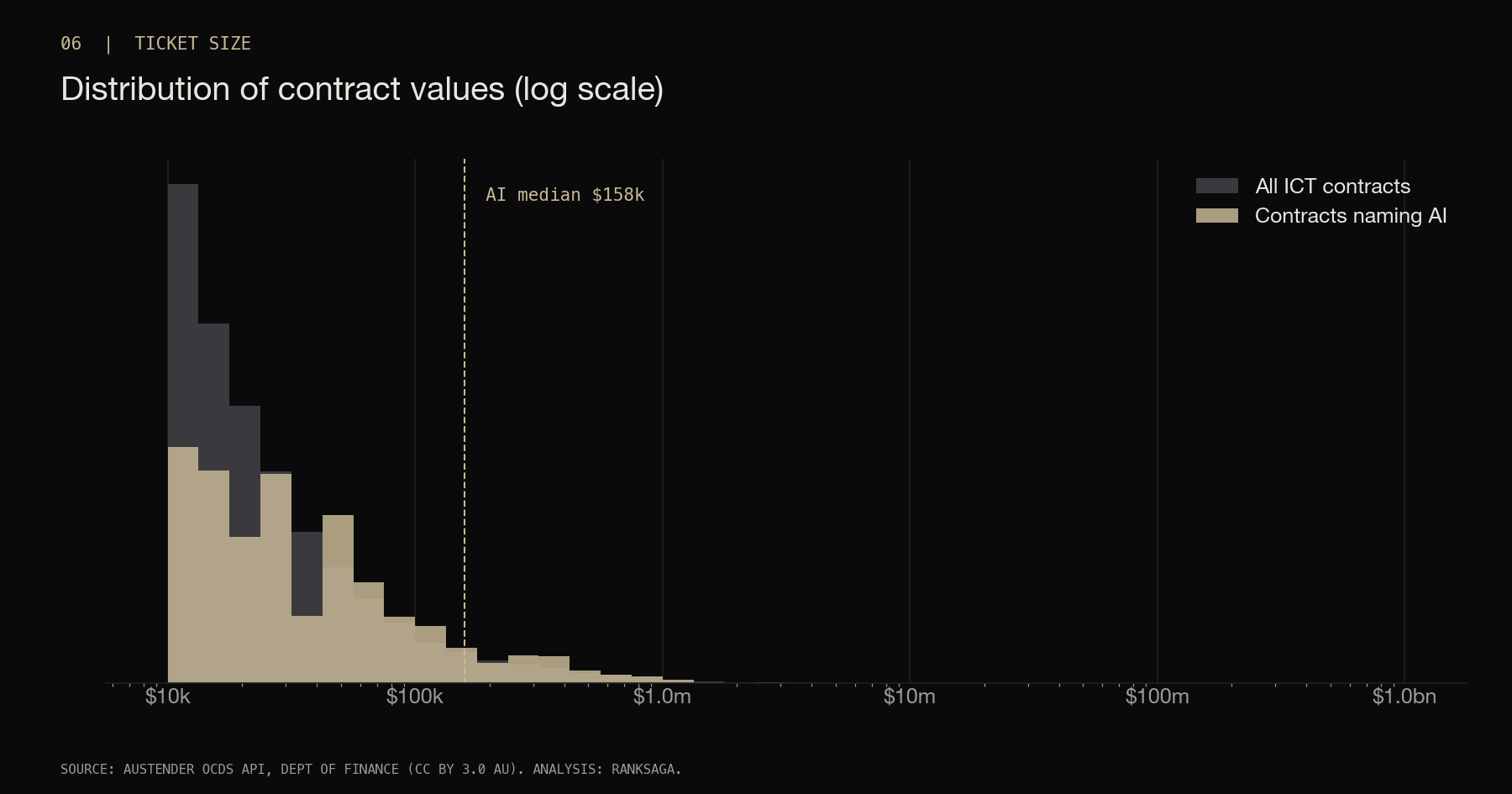
The ticket sizes are small. The median AI contract is $158k, only one exceeds $10m, and 94% are under $1m. The median contract term is 0.88 years. That is shorter than a budget cycle, and shorter than the time it takes to move a model from a pilot into an accredited production environment.
This is the pattern of an organisation running experiments, not one fielding capability. Hiring a data scientist on a 12-month labour hire contract is a reasonable way to explore a problem. It is not a way to deliver a system that someone has to operate, secure, monitor and improve for five years.
4. Defence's AI does not say "AI"
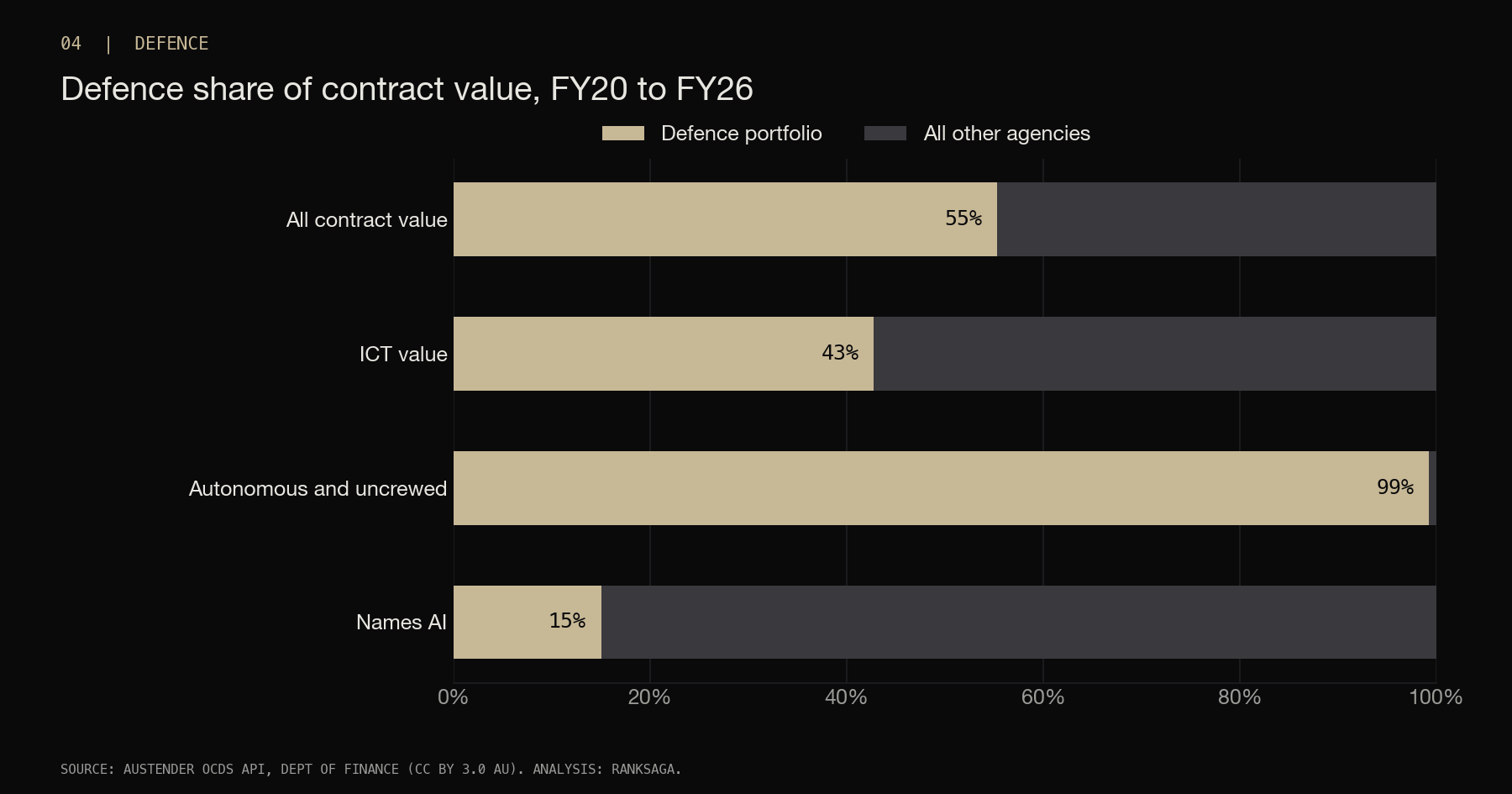
Defence is the Commonwealth's dominant buyer. It signed 55% of all contract value and 43% of ICT value from FY20 to FY26. Yet it accounts for just 15% of the value of contracts that name AI: 40 notices worth $19m over the whole period.
Look under a different word and the picture flips. Contracts for autonomous and uncrewed systems total $3.2bn, and 99% of that value is Defence. The largest single item is Anduril Australia's $1.9bn contract for autonomous undersea vehicles, signed in FY26. Before it came three FY22 notices to Insitu Pacific for tactical unmanned aerial systems totalling $753m, an uncrewed surface vessel contract with Solar Sailor worth $191m, and in FY26 a cluster of counter small uncrewed aerial systems contracts with AIM Defence and SYPAQ worth about $35m.
Not every uncrewed system is an AI system, and we have not tagged it as one. But autonomy is where machine perception, navigation, targeting support and decision software actually live in Defence. Excluding the Anduril contract, autonomy still accounts for $1.3bn, about ten times all named AI spend.
There is a second reason Defence's AI is invisible. Much of it runs on classified networks and inside platforms that are bought as hardware, sustained as services, and never described in a public notice in terms a keyword can find. The few Defence notices that do name AI are research studies (a Navy AI capability study, an AI decision support and data fusion investigation, an AI CoLab with Deakin University) and data scientist roles.
The lesson for Defence and its suppliers is that AI capability is being delivered as part of systems, not alongside them. The software has to be built for the platform and the network it will run on from the first line of code.
5. The platform layer is concentrated, and AI is arriving inside it
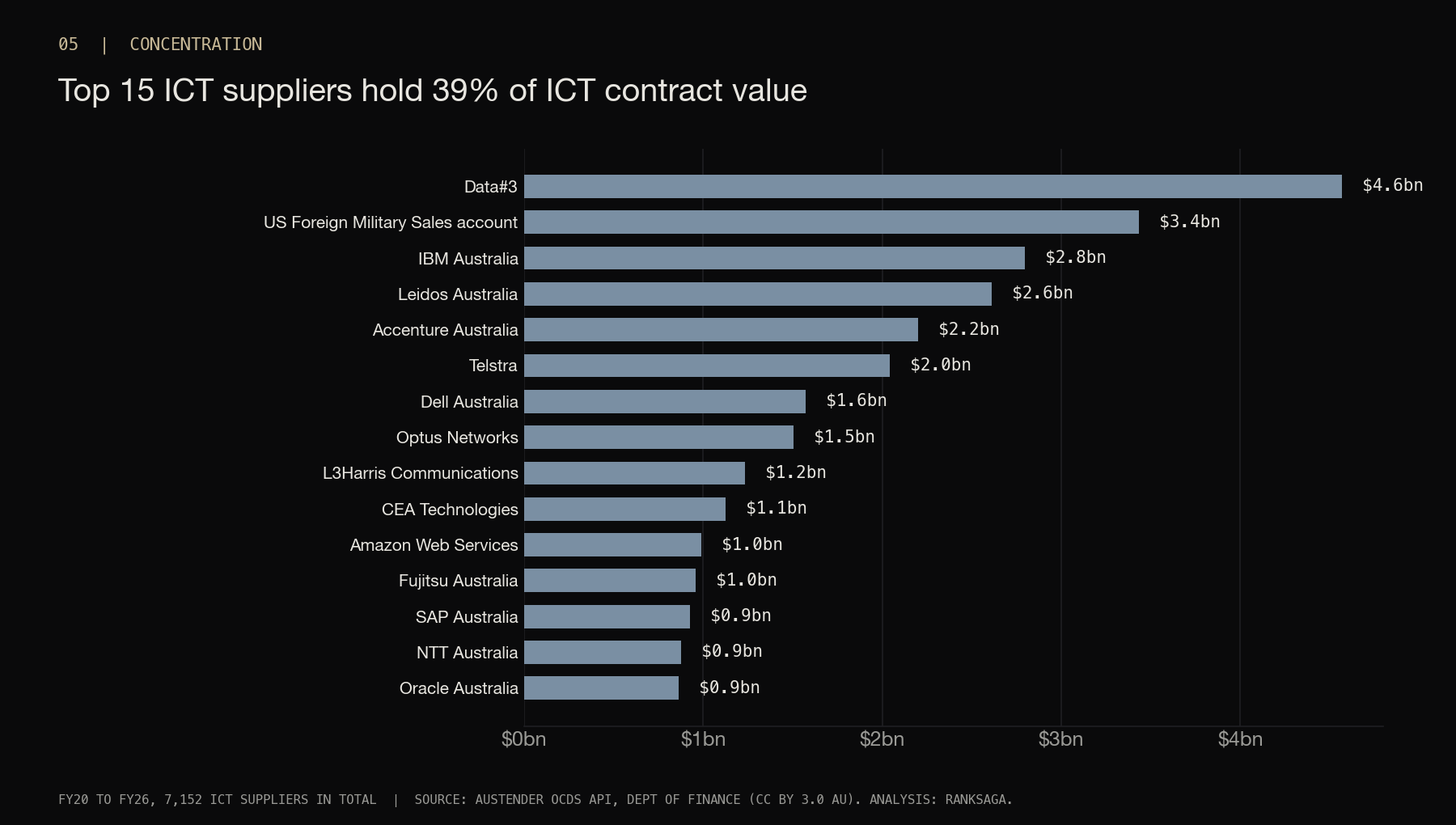
From FY20 to FY26, 7,152 suppliers won ICT contracts. The top 15 hold 39% of the value and the top 1%, about 70 firms, hold 66%. The largest is Data#3 at $4.6bn, which resells Microsoft licensing to government. Second is the account used for US Foreign Military Sales, at $3.4bn. IBM, Leidos, Accenture and Telstra follow. Amazon Web Services won $1.0bn of contracts directly.
This matters for AI because the newest AI spend is arriving through exactly these channels. The Reserve Bank's Microsoft commitment through Data#3 now lists Copilot for Microsoft 365. The Department of Foreign Affairs and Trade signed an "Enterprise AI Enablement" contract directly with AWS in FY27. The ATO's AI services came bundled with a Teradata renewal. As foundation models become a feature of every enterprise platform, AI spend will increasingly sit inside licence renewals that the procurement record describes as software subscriptions.
That is efficient for buyers in the short term. It is also how capability ends up locked into a handful of vendors, priced per seat, and hosted wherever the platform happens to run.
Who is buying
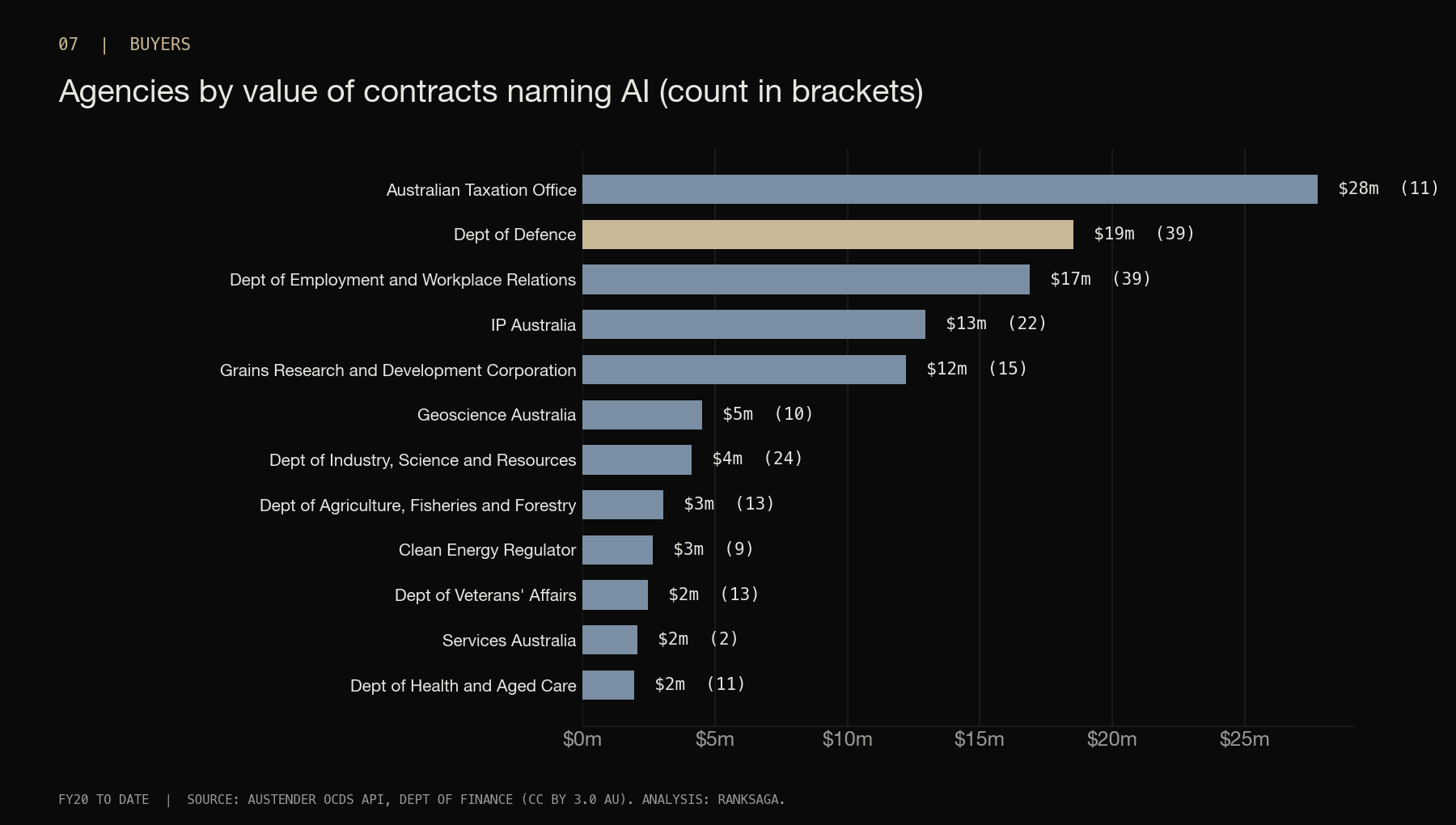
The ATO leads on value, largely because of the Teradata contract. Defence and the Department of Employment and Workplace Relations each have 39 notices, though 36 of DEWR's are data scientist roles. IP Australia has built a steady AI practice through 22 contracts, mostly machine learning engineers, AI engineers and data scientists, with a trade mark checking tool among the named projects. The Digital Transformation Agency, which sets AI policy for the whole of government, appears with 13 small contracts worth $1.6m in total.
What this means for buyers
1. Buy outcomes, not hours. A contractor on a 12-month term can prove an idea. Only an operated system turns it into capability. Contracts should define what the system must do, who operates it, how performance is measured and what happens in year three, not just how many people are on the team.
2. Make AI visible in the record. Agencies already publish AI transparency statements under the Digital Transformation Agency's policy for the responsible use of AI in government. The procurement record does not line up with them. Today it is not possible to answer "how much did the Commonwealth spend on AI last year" from public data. A simple flag on contract notices would fix that, and would let agencies benchmark against each other.
3. Decide where AI will run before deciding which model. Models change every few months. The deployment boundary does not. For Defence and national security work, that boundary is PROTECTED and above, often air-gapped, and frequently at the tactical edge. Architecture that assumes a public API endpoint will have to be rebuilt. Architecture that runs in a sovereign or disconnected environment from day one will not.
4. Fund the path from pilot to production. The median AI contract runs for less than a year. Accreditation, integration with existing systems and operator training take longer than that. If the money stops at the proof of concept, the proof of concept is where the capability stops too.
Where RankSaga fits
We build and operate AI software for Defence. Our systems run today in Microsoft Azure and in air-gapped environments for the Australian Defence Force, and we support them in operation, not just at delivery. That is the gap this data shows: plenty of pilots and plenty of people, very little operated capability.
If you are responsible for moving an AI capability from experiment to service, especially inside a sovereign or disconnected environment, see how we approach defence software and air-gapped deployment, or talk to us.
Method and limitations
- Contract notices are commitments, not spend. Values are the total contract value at signing, updated by amendments. Actual payments can be lower, and multi-year contracts are counted in the year they were signed.
- Coverage. Notices are required for contracts of $10,000 or more by agencies subject to the Commonwealth Procurement Rules. Some contracts are exempt from publication for national security reasons, which will understate Defence and intelligence spend.
- Keyword tagging is a floor. Contract descriptions are short and inconsistent. A contract described as "Software support" can be an AI platform. Our AI figures count what agencies chose to describe as AI, which is the point of this analysis, but they understate true AI spend.
- Precision. We reviewed every contract tagged as naming AI and removed false positives. Autonomous and uncrewed systems are a separate category and are not counted as AI.
- Data science roles. We include data science in "names AI" because agencies use those roles to build machine learning capability. Figures excluding data science roles are given alongside.
- Agency names change with machinery of government changes. We report agencies as named on each notice.
Source: AusTender contract notices via the Department of Finance OCDS API, retrieved 23 November 2026, licensed under CC BY 3.0 AU. Analysis and charts by RankSaga.