

The AI job market has moved from niche to mainstream. Whether you're hiring for LLM engineers, prompt engineers, or AI product managers, or you're looking for your next role, understanding where salaries sit, which skills are in demand, and how work models are shifting can help you make better decisions. This post uses a dataset of 1,500 AI job postings from 2025 and 2026 (AI Jobs Market 2025–2026, Kaggle) to answer those questions with concrete numbers and visualizations.
We cover salary distribution and tiers, pay by role and experience level, geography and remote work, the skills employers ask for most, demand and growth by category, and the AI salary premium. We also include a short note on data and methodology at the end.
The big picture
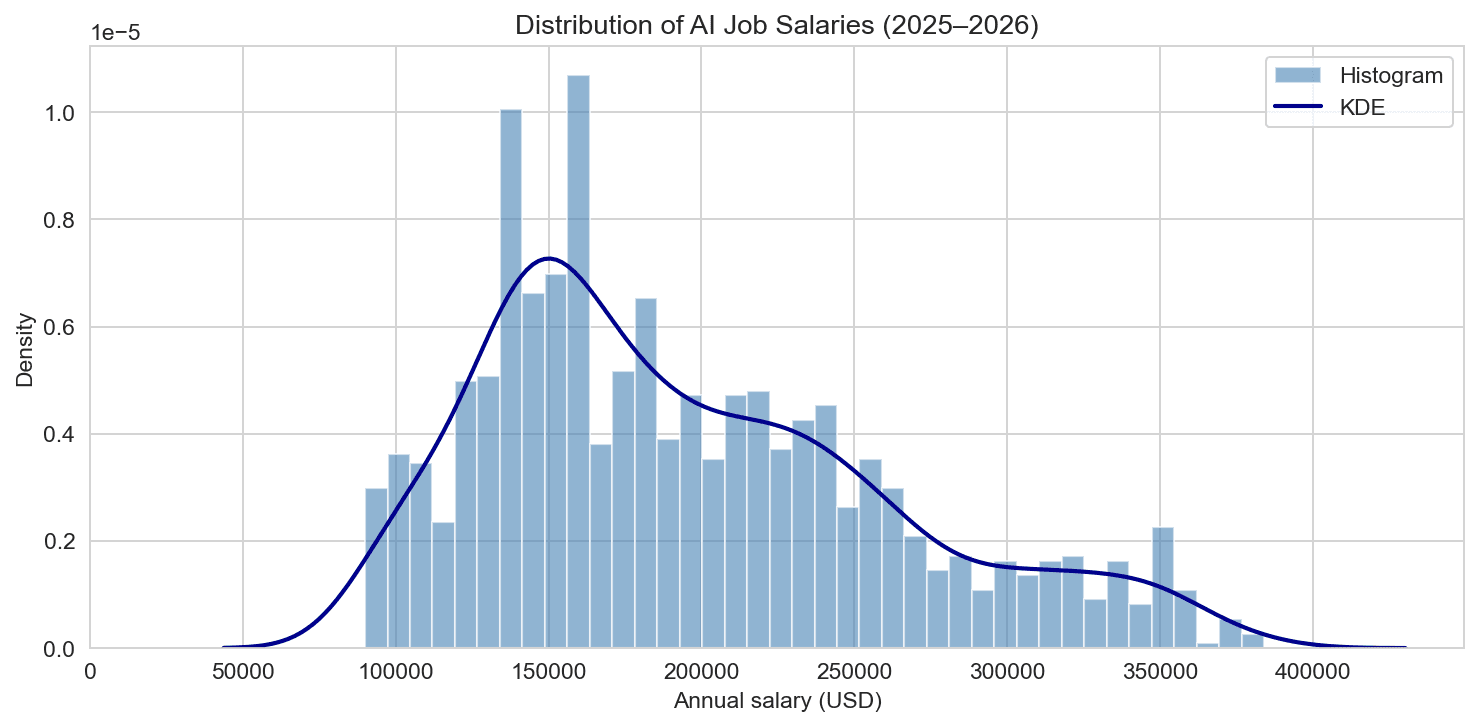
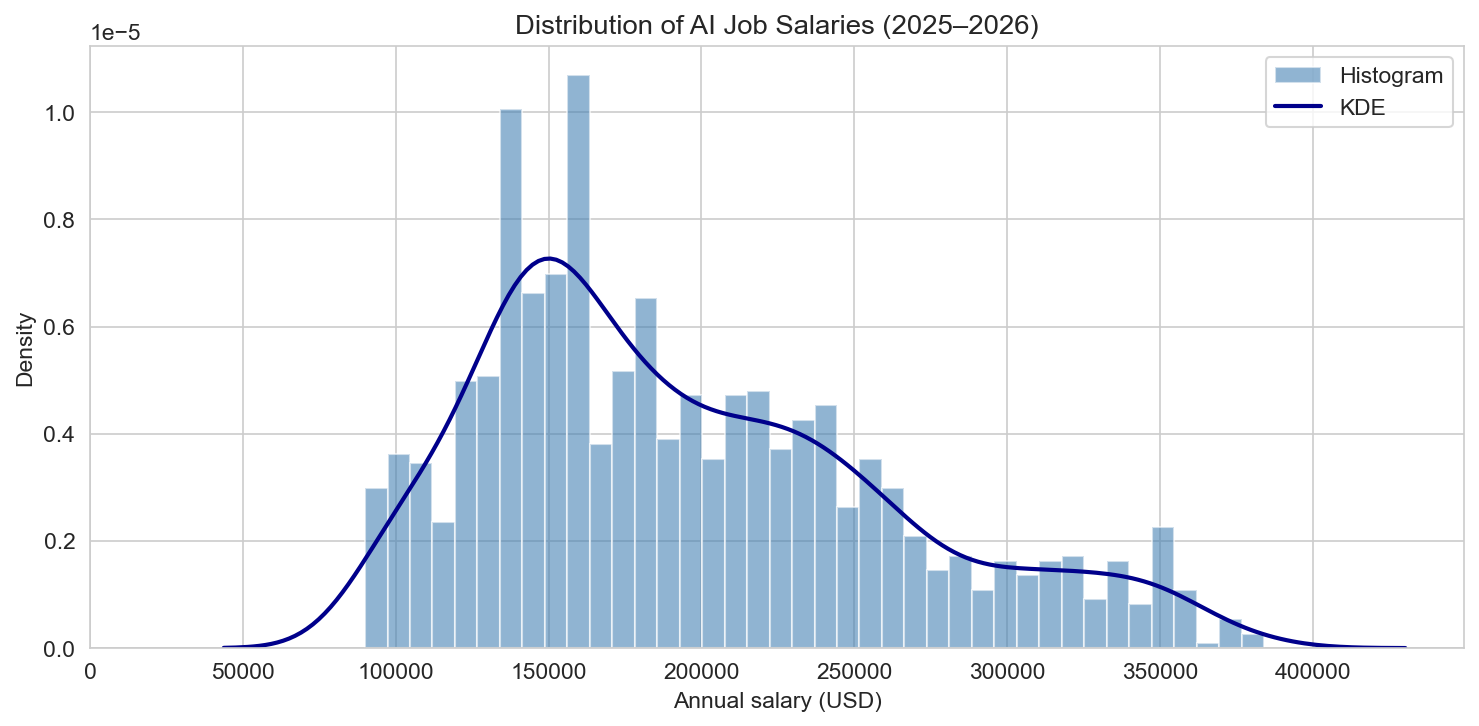
Salaries in this sample are concentrated in the mid to upper range. The median annual salary is $180,000 and the mean is about $195,000. The distribution is right-skewed: many roles sit in the $150k–$250k band, with a long tail into the $300k+ “elite” tier.
- Salary tiers: About one-third of postings fall in the Senior ($200–300k) band; Upper-Mid ($150–200k) and Mid ($100–150k) each account for a large share. Elite (over $300k) and Entry (under $100k) are smaller but still present.
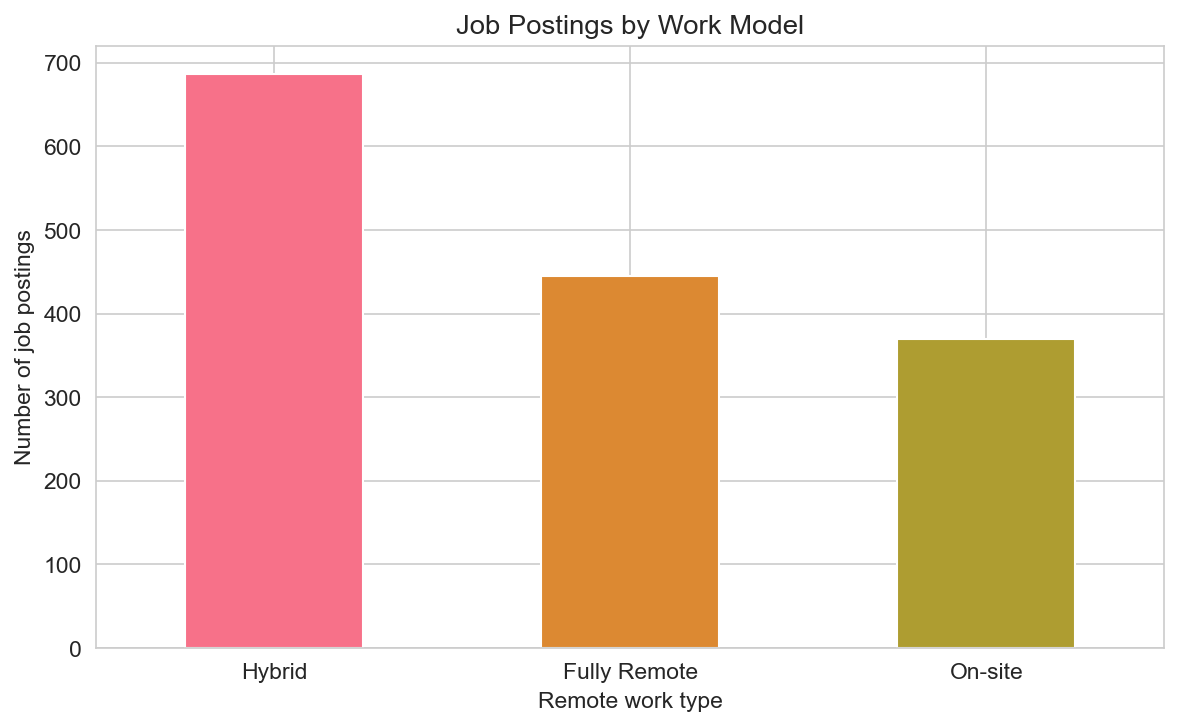
- Work model: Hybrid is the most common arrangement, followed by Fully Remote, then On-site. Roughly 75% of postings are remote-friendly (hybrid or fully remote), so flexibility is the norm rather than the exception.
- Roles: AI Engineering dominates by volume (about half of all postings), with Data Science, Governance, Robotics, Product, and Business roles also well represented across 12 job categories.
Who pays what
Salary by job category
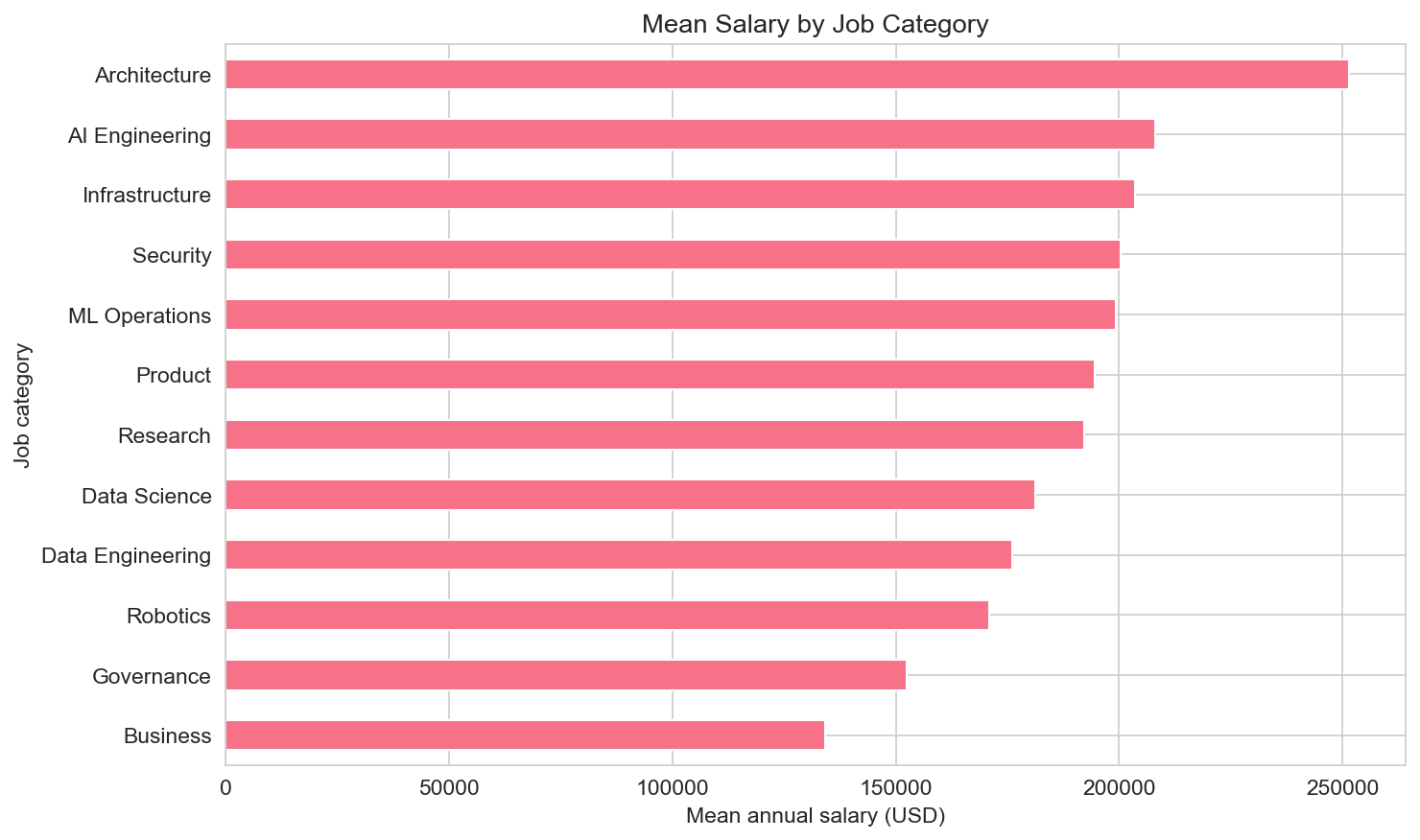
Architecture roles (e.g. AI Solutions Architect) command the highest mean salary in this dataset (around $252k), followed by AI Engineering (about $208k) and Infrastructure (about $204k). Data Science, Data Engineering, and MLOps sit in the upper-mid range; Governance, Business, and Research roles show slightly lower means but still strong pay. So “who pays what” is clearly role-dependent: architecture and core AI/ML engineering lead, with supporting and cross-functional roles not far behind.
Salary by experience level
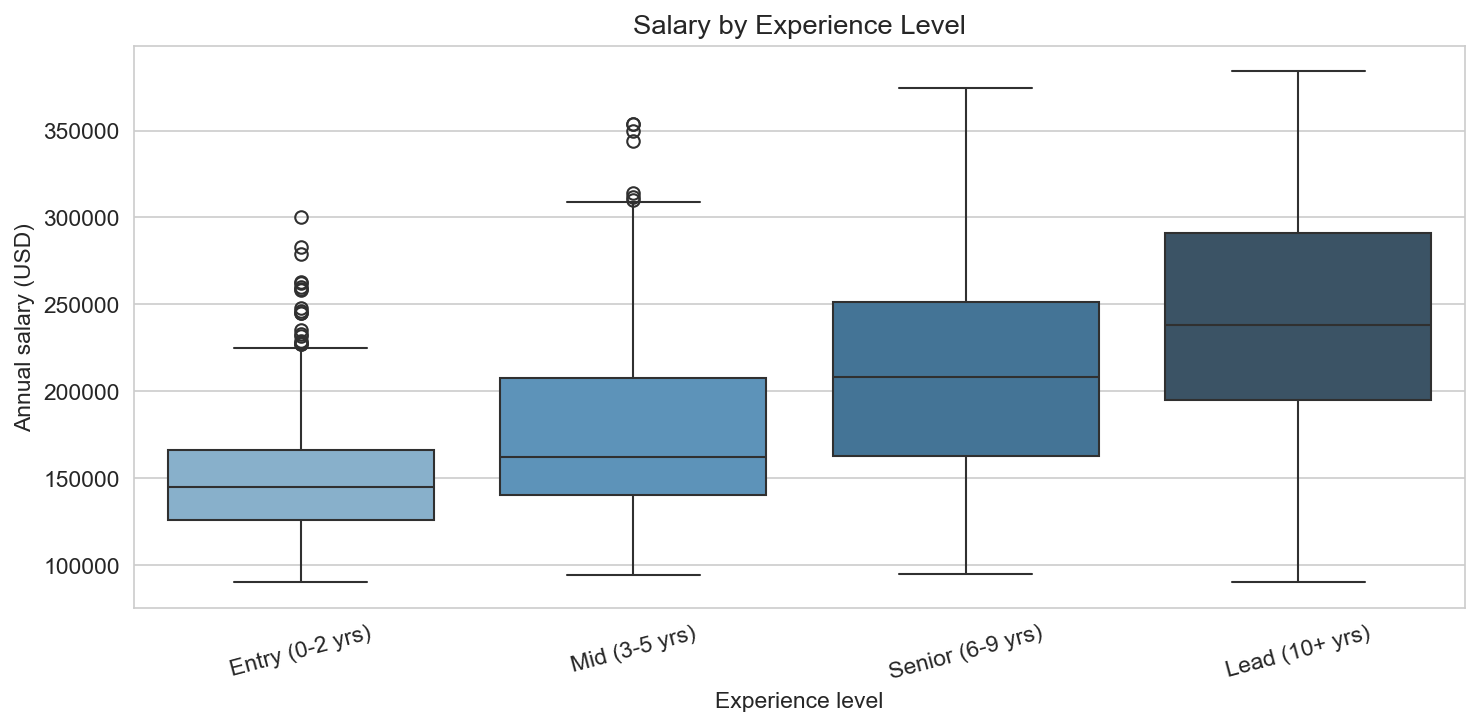
Pay rises with seniority. Entry (0–2 years), Mid (3–5), Senior (6–9), and Lead (10+) show a clear step-up in both median and spread. Lead and Senior roles drive the right tail of the distribution; Entry and Mid roles are more concentrated in the $100k–$200k range. If you’re benchmarking offers, use experience level as a first filter before comparing to role and location.
Salary by geography
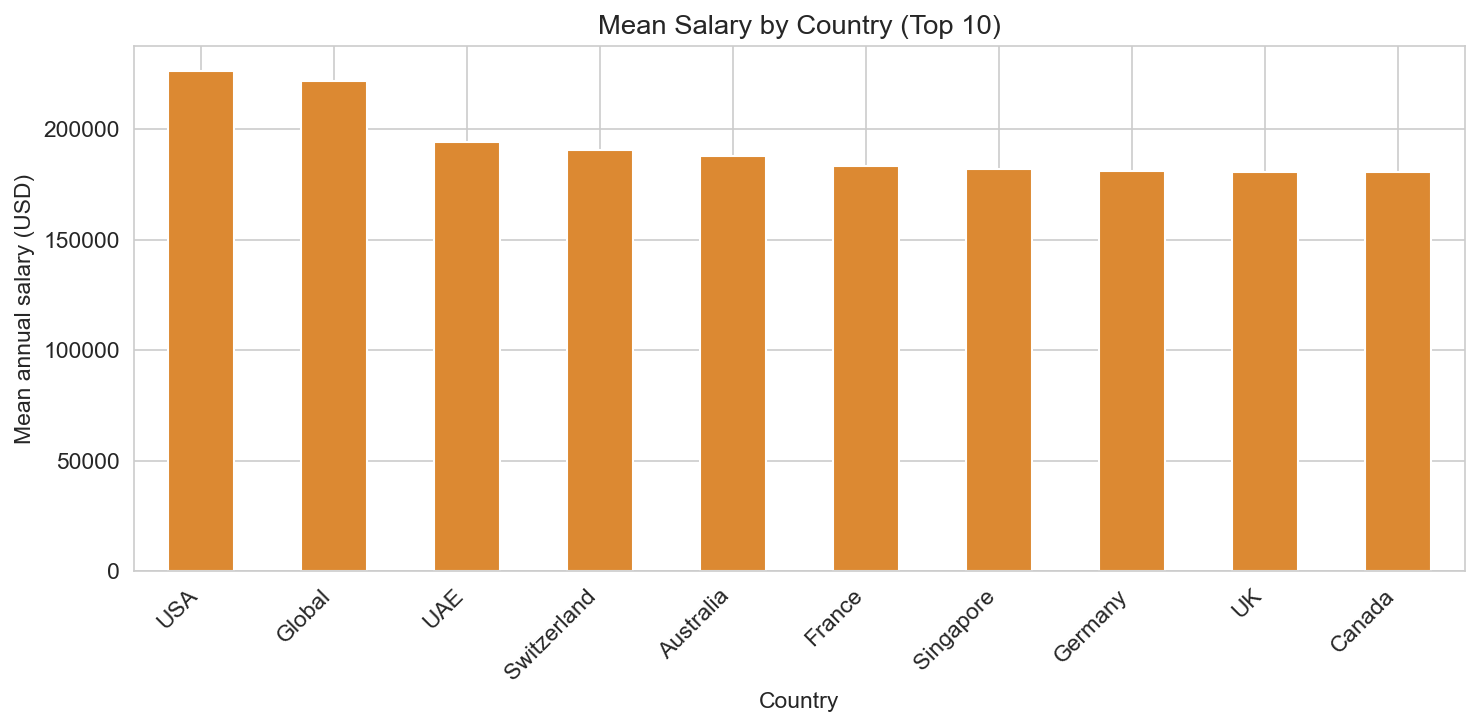
Among the top 10 countries by posting volume, USA has the most listings and strong mean salaries. Switzerland stands out at the top of the pay scale in this sample, with USA, Australia, and UK also in the upper band. India and China show lower mean salaries in USD, reflecting local market and cost-of-living differences. So “where the jobs are” and “where they pay the most” are related but not identical: high volume and high pay both matter depending on whether you care about options or absolute compensation.
Salary by remote work type
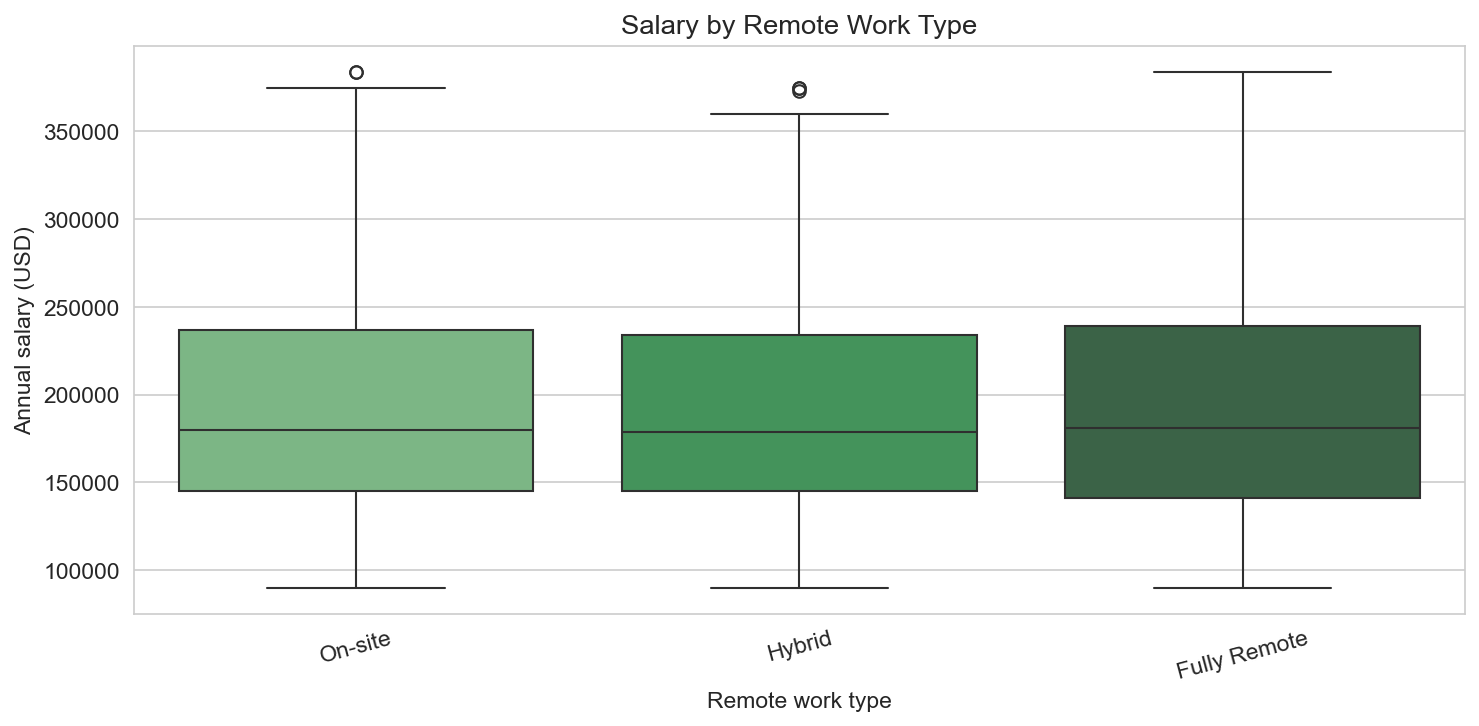
Mean pay is similar across On-site, Hybrid, and Fully Remote in this dataset (all in the ~$193k–$198k range). So remote-friendly roles are not, on average, paying less; employers are competing for the same talent whether the role is on-site or remote. That’s good news for candidates who prefer flexibility.
Salary by company size
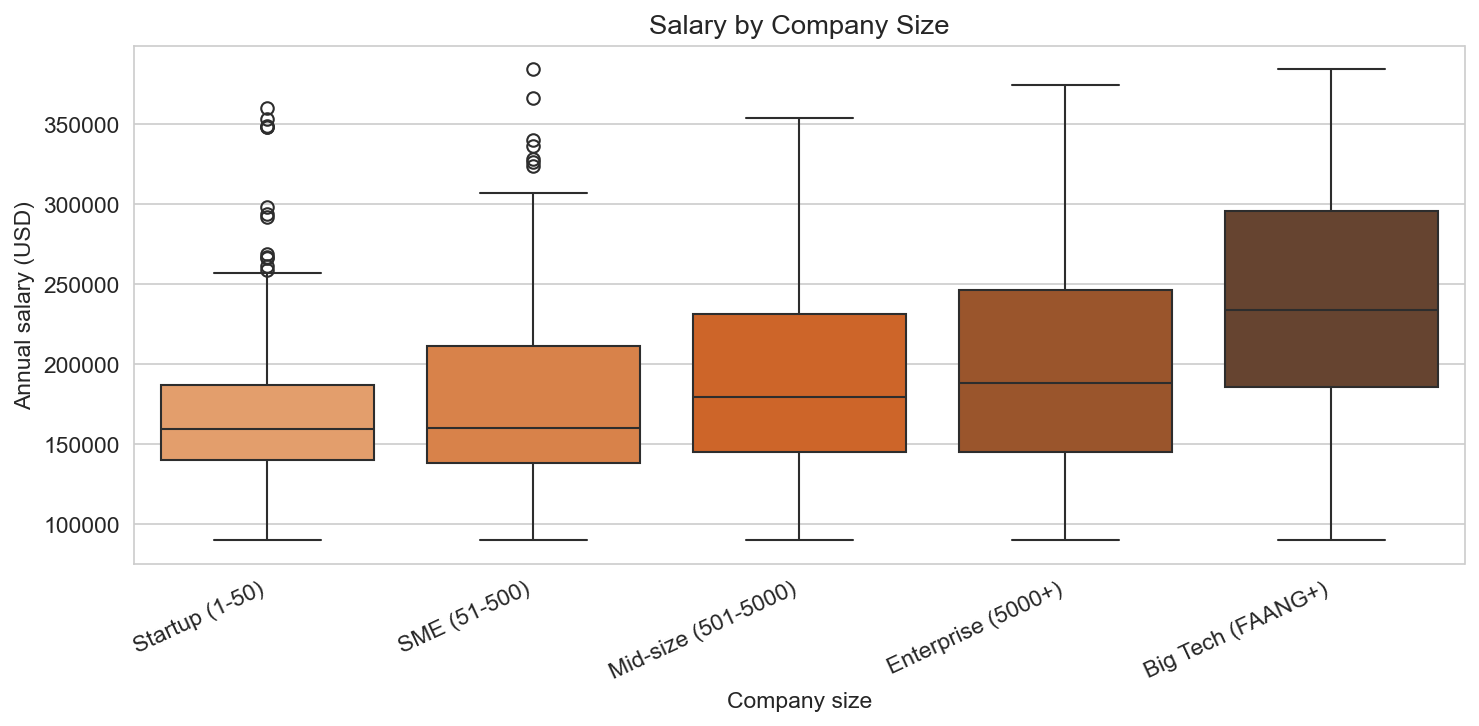
Larger employers (Big Tech, Enterprise, Mid-size) tend to show higher medians and more spread than Startups and SMEs, though there is overlap. So “who pays what” also depends on company size: big tech and enterprise lead on pay; startups and SMEs can still offer strong packages, especially for senior and specialist roles.
Where the jobs are
Geographically, USA leads by a large margin (over 500 postings), followed by UK, China, Canada, and Global (remote-without-specific-country) listings. Major tech hubs (e.g. San Francisco, New York, Seattle, London, Singapore, Berlin) appear frequently in the city field. Remote-friendliness is high overall: the majority of postings are Hybrid or Fully Remote, so “where the jobs are” is often “everywhere,” with a strong concentration in the US and a long tail of international and global-remote roles.
What employers want
Top skills
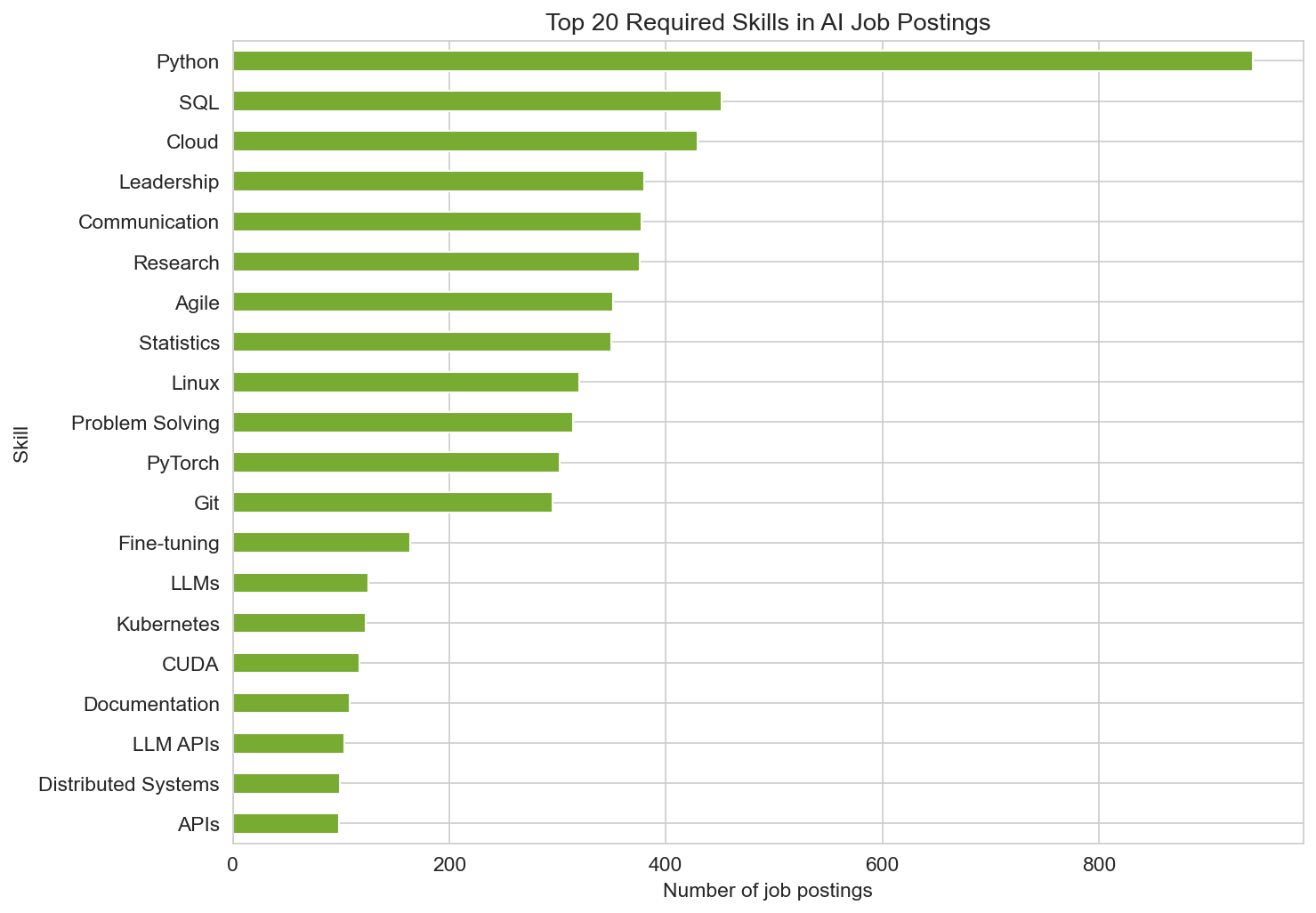
The most frequently required skills in the dataset are Python, Communication, Problem Solving, SQL, Agile, Cloud, Research, Leadership, Statistics, Git, and Linux. LLM-oriented skills (e.g. LLM APIs, Prompt Design, Fine-tuning, LangChain, Vector DBs, RAG) show up often in AI Engineering and related roles. So the mix is classic software and data (Python, SQL, cloud, git) plus collaboration (communication, agile, leadership) and, in many postings, explicit LLM/GenAI stack (APIs, prompts, fine-tuning, tooling).
LLM vs non-LLM roles
About 22% of postings are tagged as LLM-focused roles. These roles tend to cluster in AI Engineering (e.g. Prompt Engineer, LLM Engineer, RAG Engineer, AI Agent Developer) and often list skills like LLM APIs, prompt design, vector DBs, and LangChain. Demand scores and salary levels for these roles are competitive with the rest of the market, so specialization in LLMs is not trading off pay in this sample.
Demand and growth by category
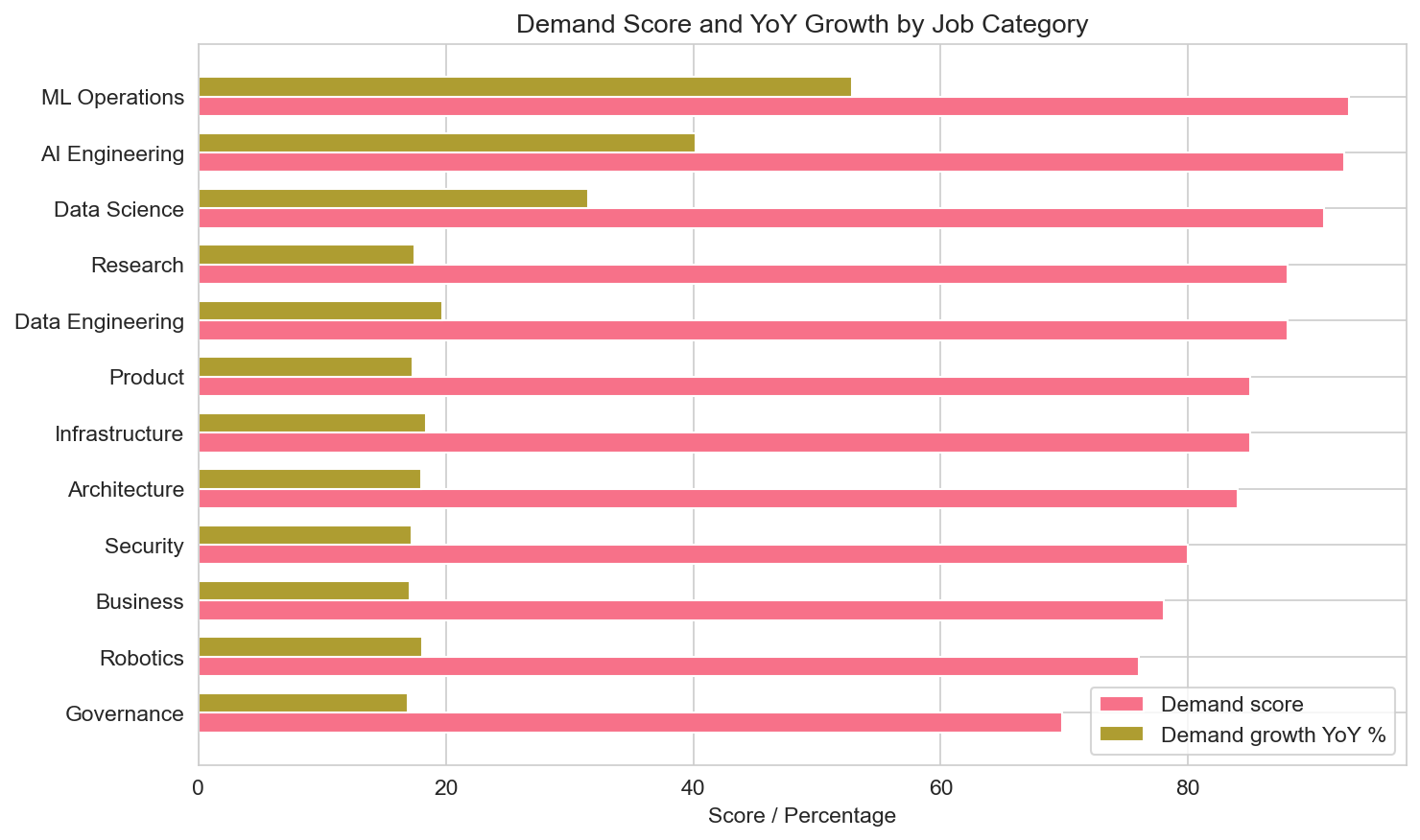
Demand scores and year-over-year demand growth vary by job category. AI Engineering, Data Science, MLOps, and Infrastructure show high demand and solid growth; Governance and Robotics show slightly lower demand scores but still meaningful activity. So “what employers want” is both broad (Python, communication, problem solving) and specialized (LLMs, MLOps, security, governance), with demand and pay aligned for the most in-demand categories.
Industry and premium
Industries hiring
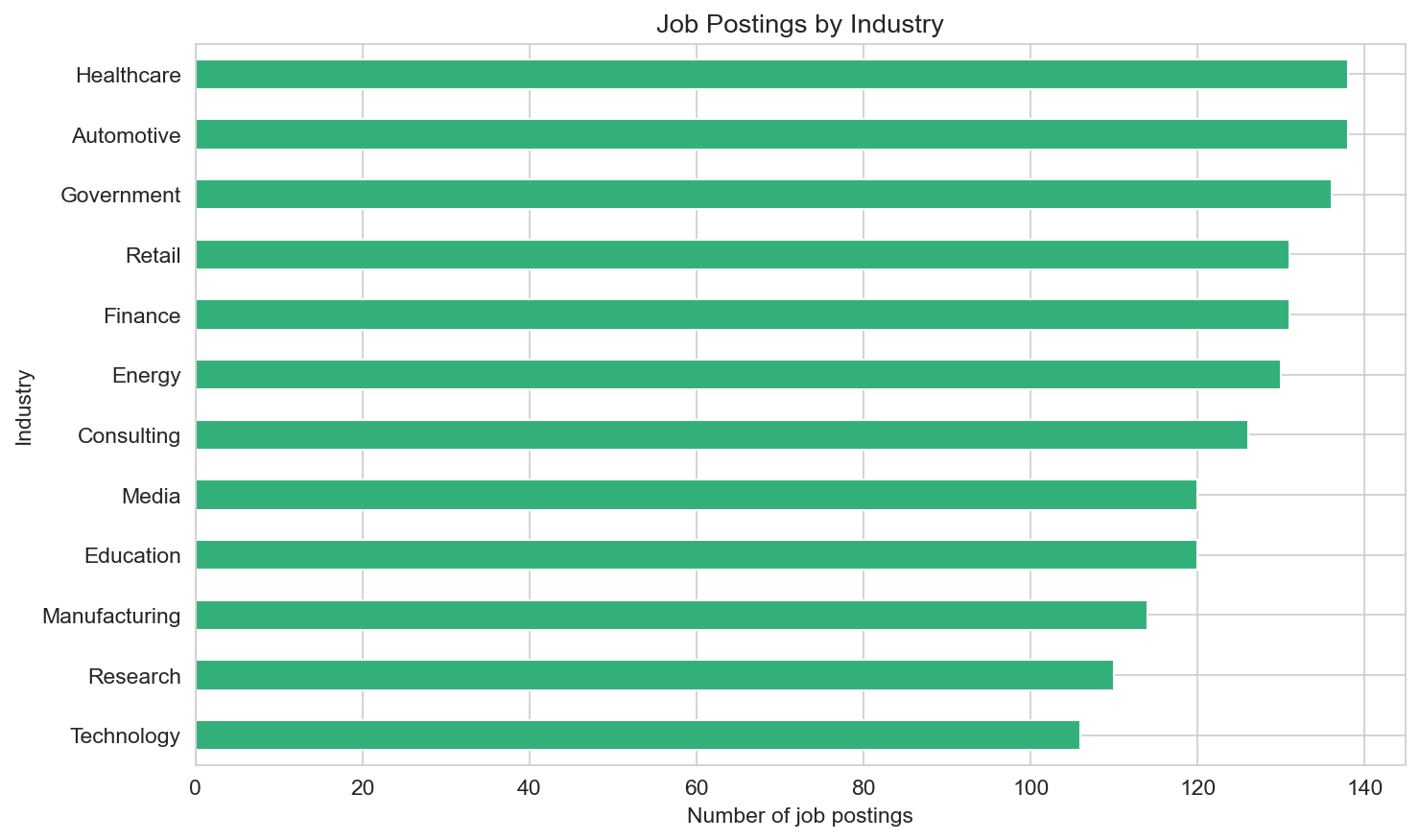
Postings span Automotive, Healthcare, Government, Finance, Retail, Energy, Consulting, Education, Media, Manufacturing, Research, and Technology. No single industry dominates; hiring is spread across the economy. That suggests AI talent is in demand not only in tech but in regulated and traditional industries as they adopt AI.
AI salary premium
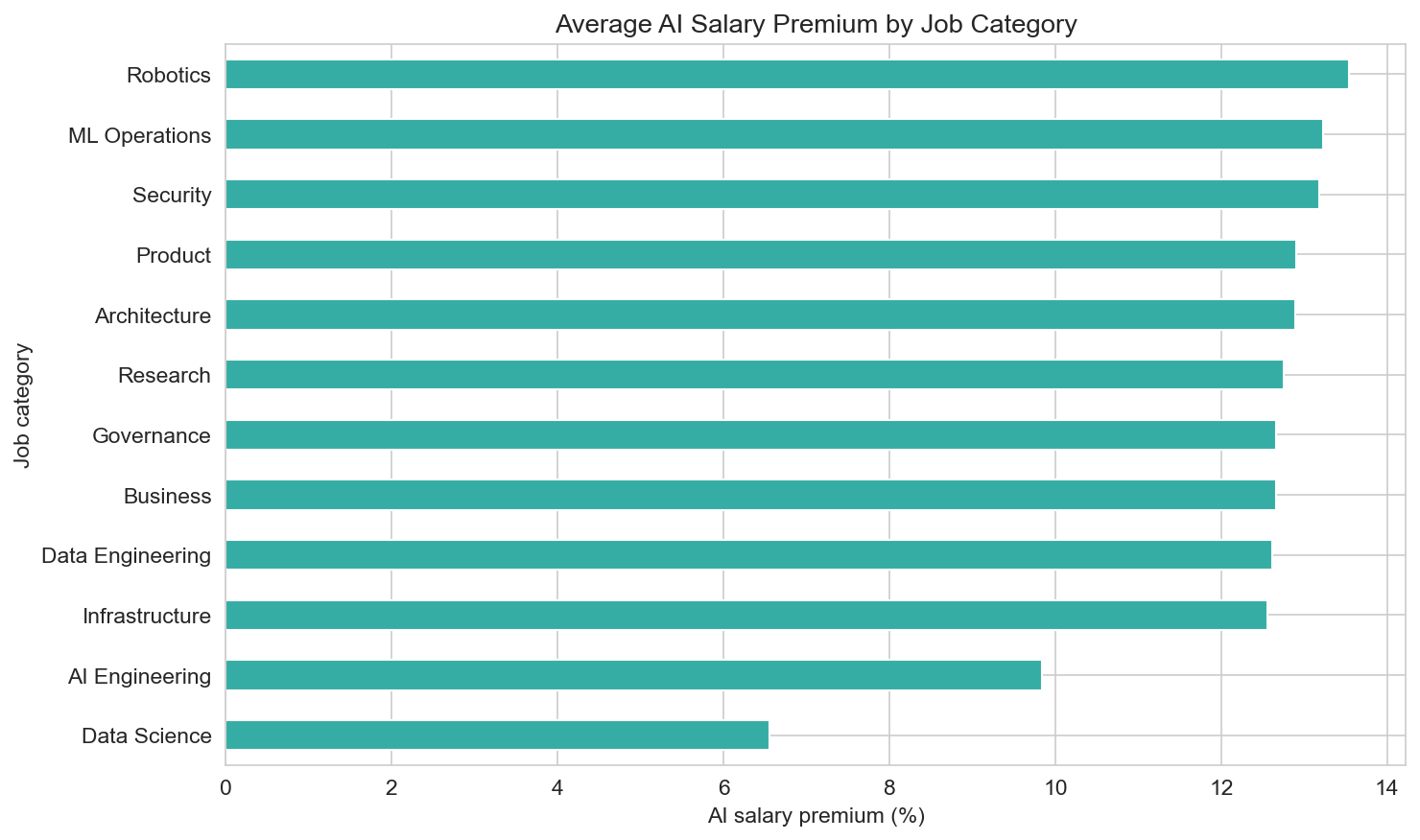
The dataset includes an AI salary premium (percentage over a baseline). On average, roles in Security, Business, Governance, and Robotics show higher premiums in this sample; AI Engineering and Data Science also show a positive premium. So employers are paying a premium for AI-related skills across roles, not only for “pure” AI titles.
Posting trend
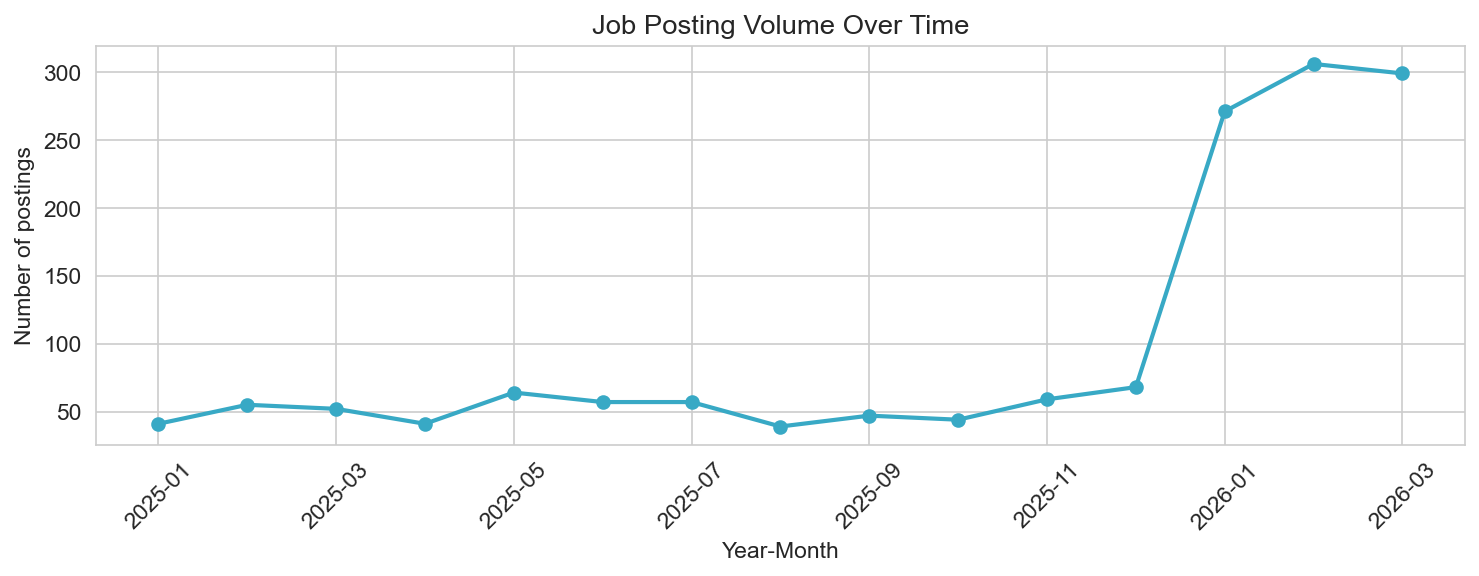
Posting volume by month shows more activity in 2026 than in 2025 in this sample, consistent with continued growth in AI hiring. Seasonal or monthly variation is visible, but the overall trend is upward.
Practical takeaways
For job seekers
- Focus on Python, SQL, cloud, communication, and problem solving as a base; add LLM APIs, prompt design, RAG, and vector DBs if you target LLM/GenAI roles.
- Use experience level and job category to benchmark salary; median around $180k and mean around $195k are useful anchors for mid-to-senior roles.
- Remote-friendly roles are common and do not, on average, pay less—prioritize flexibility if it matters to you.
- Geography still matters for level of pay (e.g. Switzerland, USA, Australia vs. India, China in USD); consider cost of living and visa implications.
For employers
- Salaries are competitive; Senior and Lead bands ($200k–$300k+) are the norm for experienced AI/ML talent.
- Hybrid and Fully Remote are standard; offering flexibility is table stakes in many segments.
- Highlight LLM/GenAI skills and projects if you’re hiring for those roles; demand and pay are aligned.
- Demand is high across AI Engineering, Data Science, MLOps, and Infrastructure—expect competition for the same talent pool.
Conclusion
The AI job market in 2025–2026, as reflected in this sample of 1,500 postings, is characterized by strong salaries (median $180k, mean ~$195k), a majority of remote-friendly roles, and demand spread across job categories and industries. Architecture and AI Engineering lead on pay; Python, communication, and LLM-related skills lead on requirements. Whether you’re job hunting or hiring, using data like this to anchor expectations on salary, skills, and work model can make the process more transparent and effective.
Data and methodology
The analysis is based on the AI Jobs Market 2025–2026 dataset (Kaggle: alitaqishah/ai-jobs-market-2025-2026-salaries): 1,500 job postings with fields for job title, category, experience level, education, salary (annual/min/max in USD), location (city, country), remote work type, company size, industry, required skills (pipe-separated), demand score, demand growth YoY %, AI salary premium %, benefits score, and posting year/month. Figures were generated with pandas and seaborn; all charts use the same sample. Salaries are in USD; no cost-of-living or purchasing-power adjustments were applied. The dataset may include synthetic or aggregated sources; treat the numbers as indicative of market structure rather than as a definitive census of all AI roles.